
Gardens
Gardens aims agreed in 2023
Our aim is to conserve and enrich one of the finest woodland gardens and Cornish landscapes for the benefit of current and future family members, and visitors. We will increase biodiversity by using environmentally sustainable, low-intensity gardening techniques, creating more wildlife-friendly habitats. We will protect our rich natural resources, our veteran trees and the Atlantic woodland (temperate rain forest) biodiverse habitat of the Cascades. We intend to balance this with meeting the social, sporting, walking and recreational wishes of the family.
Newsletters
You can access all Gardens Newsletters (2020 on) HERE
On 16 November 2022, Pippa Latham succeeded Caroline as Gardens Director and a Director of TEL. Pippa’s first Gardens Newsletter is HERE.
Caroline Latham retired from her roles as Gardens Director and a TEL Director after the AGM on 16 November 2022. You can see photos showing some of the changes in the gardens during her tenure 2000 - 2022 HERE. Caroline’s farewell Newsletter is HERE.
Visit by the Ancient Tree Forum
On 6 September we had an all-day visit by the Ancient Tree Forum (Cornwall Group). which records ancient and veteran trees. They provided a commentary afterwards, which you can see HERE. The introduction says:
Trebartha has a very good population of ancient and veteran trees. It is a gem within the Lynher valley - a wider landscape that seems to have an above average population of these highly valuable trees. More surveying and recording will reveal the true extent and the evidence of other special populations of fungi invertebrates and lichens.
As of August 2021 a total of26 ancient and other veteran trees have been recorded on the immediate estate plus 13 on the adjacent wood pasture to the south west. It is anticipated that many more exist on surrounding pasture, floodplain and woodlands in tenanted land of the estate, which could be the target of future recording surveys.
The commentary gives a lot of advice on how to manage trees, not all of it consistent with previous advice! We were also given a book with further guidance.
Emma Latham Phillips was able to join the group, and she made some notes afterwards, which you can see HERE.
Their findings are added to the Ancient Tree Inventory - see https://ati.woodlandtrust.org.uk. If you search for Trebartha, you have to home in a map and then home in further to individual trees. Ancient trees have orange markers, veteran trees have green markers. If you click on a marker, you can click again on the tree ID, and then click again again on “show more” to get all the recorded information. It is rather a cumbersome process! As an example, to get all the recorded information on the veteran oak in the corner of donkey park field nearest skew bridge:
First search https://ati.woodlandtrust.org.uk. for Trebartha; you get this map showing the location of all the recorded trees
if you click the marker for this tree, and then click the tree ID, you get to this
if you then click ‘Show more’. you get this
Unfortunately for us, there is no simple list!
Their previous visit was in 2012. They want to come again in 2022.
Surveys of our wildlife and biodiversity
We had further visits by experts to record lichens and mosses in 2022, following surveys of plants and fungi in 2021. All our surveys can be found HERE.
Ferns, lichens, mosses and liverworts
Plantlife has been running a project ‘Building Resilience in South West Woodlands’. Trebartha is within the UK’s temperate rainforest, and its woodlands are internationally important for their lichens and bryophytes (mosses and liverworts). Moira has been learning more about ferns, lichens, mosses and liverworts with Plantlife, which we hope will help us to recognise, understand more about these ‘lower order’ plants, value and conserve them.
This project ties in neatly with the recent visit by the Ancient Tree Forum members, who loved the ferns, mosses and lichens on our veteran and ancient trees.
The Fish Ponds
We have an Ecological Assessment and Management Advice on the Fish Ponds to share. The most exciting finding was some otter spraint who showed an otter had been in the lower pond outflow. The report was prepared by John Sproull of Ecology Partners, who visited on 1 September. This will be taken into account in the much-delayed management plan.
We may want to make further changes when we have the Land & Heritage Parkland Management Plan report, which is due by end January 2023. (This report is supported by Natural England. The objective is to create a practical 20 year management plan for the maintenance and restoration of the Parkland which surrounds the site of Trebartha Hall. It will focus on what can be achieved through the Countryside Stewardship Scheme and any subsequent agri-environment schemes.)
Email to the family 2 February 2021:
Dear family
This is an update on the fish ponds.
We sent out a consultation paper on proposals for the fish ponds on 30 November, with a closing date of 4 January.
We are delighted to have a fantastic response, from 36 family members ranging from school age to upper eighties! We are also delighted by the work and thought that has been put into the responses..
The gardens team and the TEL Board are very appreciative, and keen to continue to benefit from input from the family.
We have put all the responses together in one document for everyone to see. HERE is a link to it. There is also a link on the website.
The TEL Board meeting on 27 January received a two page report on the consultation. This report is not a full response to everything in the submissions from the family - that would be another very big piece of work! - but it indicates the gardens team’s current thinking. HERE is a link to it. There is also a link on the website. The Board does not want endless further consultation, but is very keen to continue to engage the family in plans for the gardens.
The strongest message from the family is that swimming should be possible. We accept that. Unfortunately, however, it is not practical for the gardeners to take on keeping any of the ponds clear of weed. (Cutting the swan pool weed is feasible only because the pool is shallow and level; even so, it is a big time commitment.) In any event, we want to allow weed to grow, to support biodiversity and wildlife. We. are therefore inclined to ask swimmers to undertake any limited weed management that is essential for swimming, and to respect the nesting season for water fowl. We will have to review how workable this is in practice.
We would like to respond fully to all the points everyone made, but unfortunately that would take a great deal of time and is not practicable. We will respond as well as we can. For family members who visit Trebartha, we very much welcome walks so we can discuss ideas and comments on site.
Next, the gardens team is going to draft amendments to the objectives in the consultation paper, to reflect the input from the family; and draft a Management Plan for the Fish Ponds. This will be shared with the family and further feedback will be welcome. We would also be delighted to talk to family members about the proposals, ideally, for those who can visit Trebartha, on walks around the fish ponds.
We hope to do this in time to submit a final draft to the next TEL board meeting, which is on 26 May.
Then we will start planning to consult you on other gardens areas!
Moira
On behalf of the gardens team
Caroline Latham, Gardens Director carolineattrebartha@gmail.com
Ian Sherriff, Head Gardner head.gardener.trebartha@gmail.com
Moira Latham, Caroline’s Deputy moiralatham@icloud.com
……………………………………………………………………………………………………………………………………………………………………………………………….
Email to the family 30 November 2020:
Dear family
This email is for all Trebartha shareholders and other family members. Please share it with other members of your family if they have not received the email personally. (It is being sent to everyone on the Newsletter mailing list.)
It is very exciting that this year, for the first time in well over 100 years, we have water in all three fish ponds!
We now want your views on managing the fish ponds area.
The attached paper sets out proposals, with photographs. (Our website, trebartha.org (p/w LowerMill) will also have a link to the paper, as well as many photographs.) Please do read the paper and tell us what you think.
We would be happy to host a discussion or two on zoom during December if this might be helpful.
Please email views and comments to this email address, trebartha.gardens@gmail.com, no later than Monday 4 January.
We will carefully consider all the responses and report back.
If you are happy for your comments to be attributed to you that would be great. However, if you would prefer, we can make your comments anonymous, just mention this in your email.
With thanks for your time and your contributions,
Caroline carolineattrebartha@gmail.com
Moira moiralatham@icloud.com
and
Ian head.gardener.trebartha@gmail.com
Here is a link to a higher quality version of the labelled photograph of the fish ponds, which can also be seen below. Apologies for the poor quality of this in the attachment to the email.
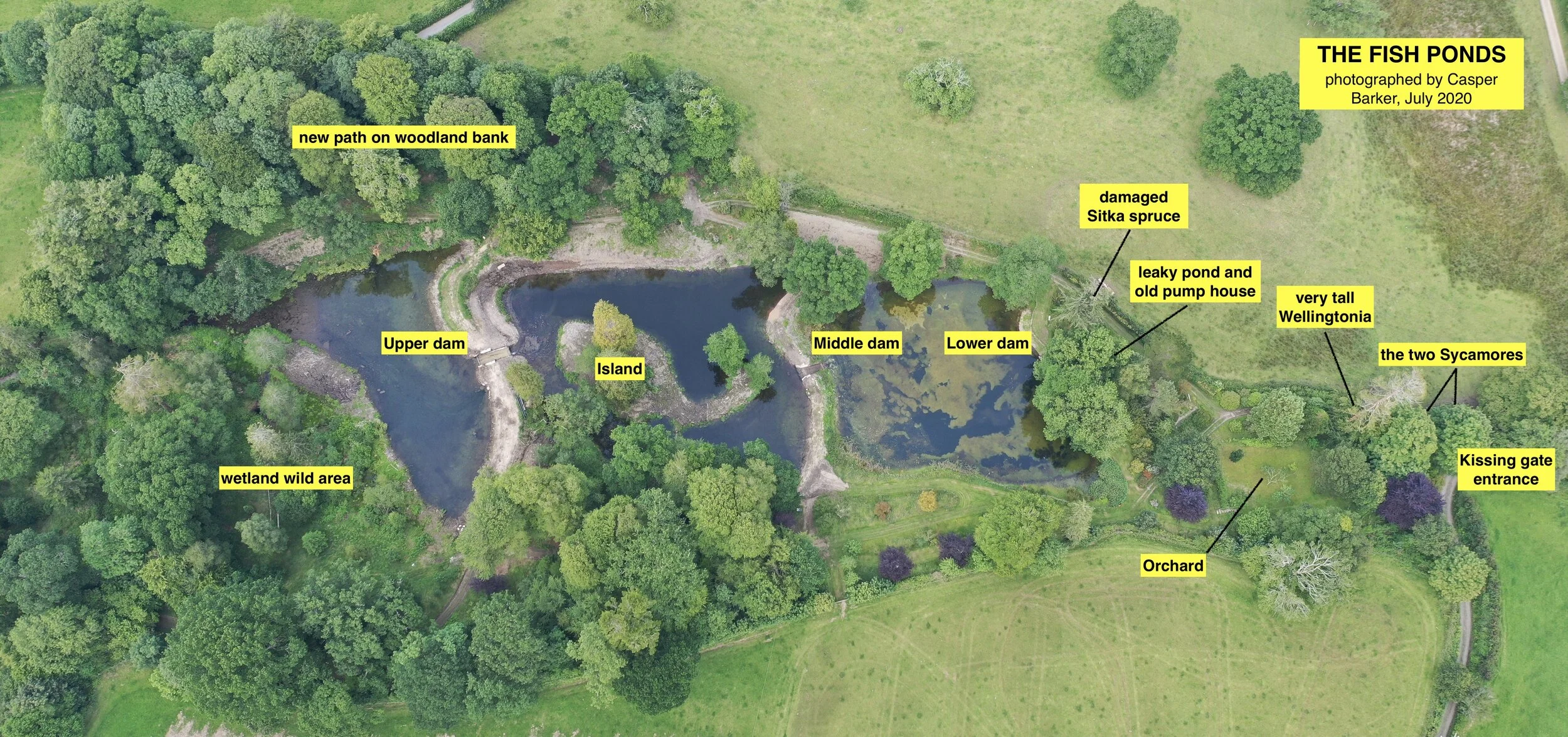
Here is a link to a high quality version of the consultation proposals than could be attached to the email.
…………………………………………..………………………………….
Gardens Open Days 2021
We usually open the gardens and Lemarne at least three times a year for the National Gardens Scheme, other charities and groups. You can learn about the NGS, and view the Trebartha Gardens NGS page and photos, by going to webpage https://ngs.org.uk.
We greatly appreciate, as well as need, family members to help on open days. Visitors come with interesting memories of Trebartha from long ago. The next scheduled open days are Sunday 25 April 2021, 2.00-5.00pm and Sunday 10 October 2021, 2.00-5.00pm.
Caroline always needs help! If you are ever able to help please let Caroline know.
…………………………………………..………………………………….
Trebartha newsletters always include news about the gardens
To access all Gardens Newsletters (No. 1 in August 2020 and No. 2 in October 2020), please use this link: Gardens Newsletters.
To access pdf files of all general Trebartha Newsletters, which usually include a section on the gardens, please use this link: Newsletters.
…………………………………………..………………………………….
Our gardeners
Trebartha Estates has two permanent staff posts, the Head Gardener, and the Assistant Gardener. There is currently a third, temporary, position of Apprentice Gardener, held by Jack Innes (started April 2019). Jack’s post is expected to continue until the end of March 2021.
Ian Sherriff is our new Head Gardener. He starts on 9 November. Ian has provided this information about himself:
I have always had a passion for plants and the natural environment which was ignited growing up exploring in the countryside of South Devon and Dartmoor. This passion lead me to completing a degree in Rural Resource Management at Seale Hayne and to follow a career in horticulture and conservation.
I have over 20 years’ experience in managing estates and gardens to a high standard with experience of working in plant nurseries, landscape gardening, working as a head gardener for a hotel and working in a botanical garden.
From 2009 – 2018 I was working as head gardener for the family run 4* Thurlestone hotel where I redeveloped the gardens, installing formal gardens for the enjoyment of the hotels guests and as a popular wedding venue. I started several community events working closely with the local school, giving school talks, running trips to see the wildlife in the garden and helped them to manage their allotment in the school grounds. I also managed the wider grounds which incorporated small pockets of woodlands, hedgerows, terrace gardens, a 9-hole golf course, wildlife garden, and poly-tunnels.
Most recently I have been working at Paignton Botanical Gardens maintaining and developing the wider grounds, gardens and nursery found within Paignton Zoo to ensure an exceptional environment for the zoo’s animals, wildlife and as a visitor experience. In this role I worked with a wide range of tropical, rare, and notable plant species, including several National Plant Collections.
I live just outside of Plymouth with Lorna my wife and our 3 children and 2 pet tortoises. Recreationally I enjoy walking, fishing, reading and continuing to explore the countryside with my children.
Information prepared for enquirers about the Head Gardener vacancy (July 2020) can be seen here; additional information given to shortlisted candidates (August 2020) can be seen here.
He succeeds Jim Briggs, who was here from February 2016 to August 2020, and achieved a great deal while he was here - as evidenced in photographs of the gardens! He left to take up a “once in a lifetime” job opportunity.
Marc Baudouy has been our Assistant Gardener since July 2017. He will be leaving for a new post on a private estate in Devon at the end of November, taking him back to his first love, conservation. It is a good career move and we wish him well. In his resignation letter, Marc writes:
I would also like to say thank you to all the Latham family and friends that I have met and who have been very kind and a pleasure to interact with …. The history and long development, maturing and continuous improvement of the Gardens have made them a very special and rich place to work, wonder and marvel!
…………………………………………..………………………………….
The new play equipment in the American Garden is now surrounded by impact-absorbing play bark.
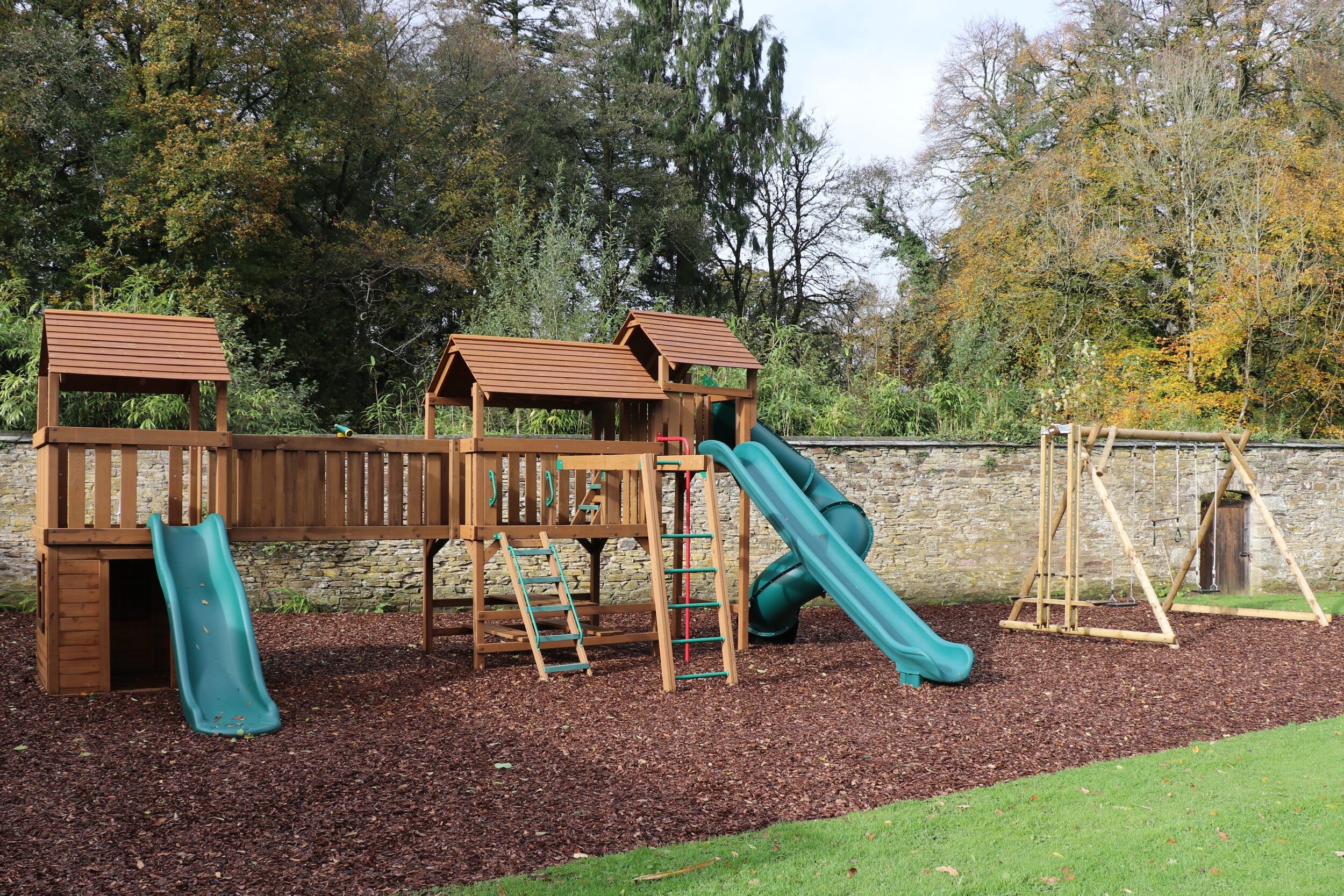
The new play equipment in the walled garden (31 October 2020).
This was purchased with using family donations, because the old equipment was rotting and unsafe.
…………………………………………..………………………………….
Repairs to the walled garden walls
The gardens budget has to cover expenditure such as repairs to the walls in the walled garden. We are gradually working through what needs to be done, with Dave Brown coming in every autumn to do some more. Here he is at work in October 2020:
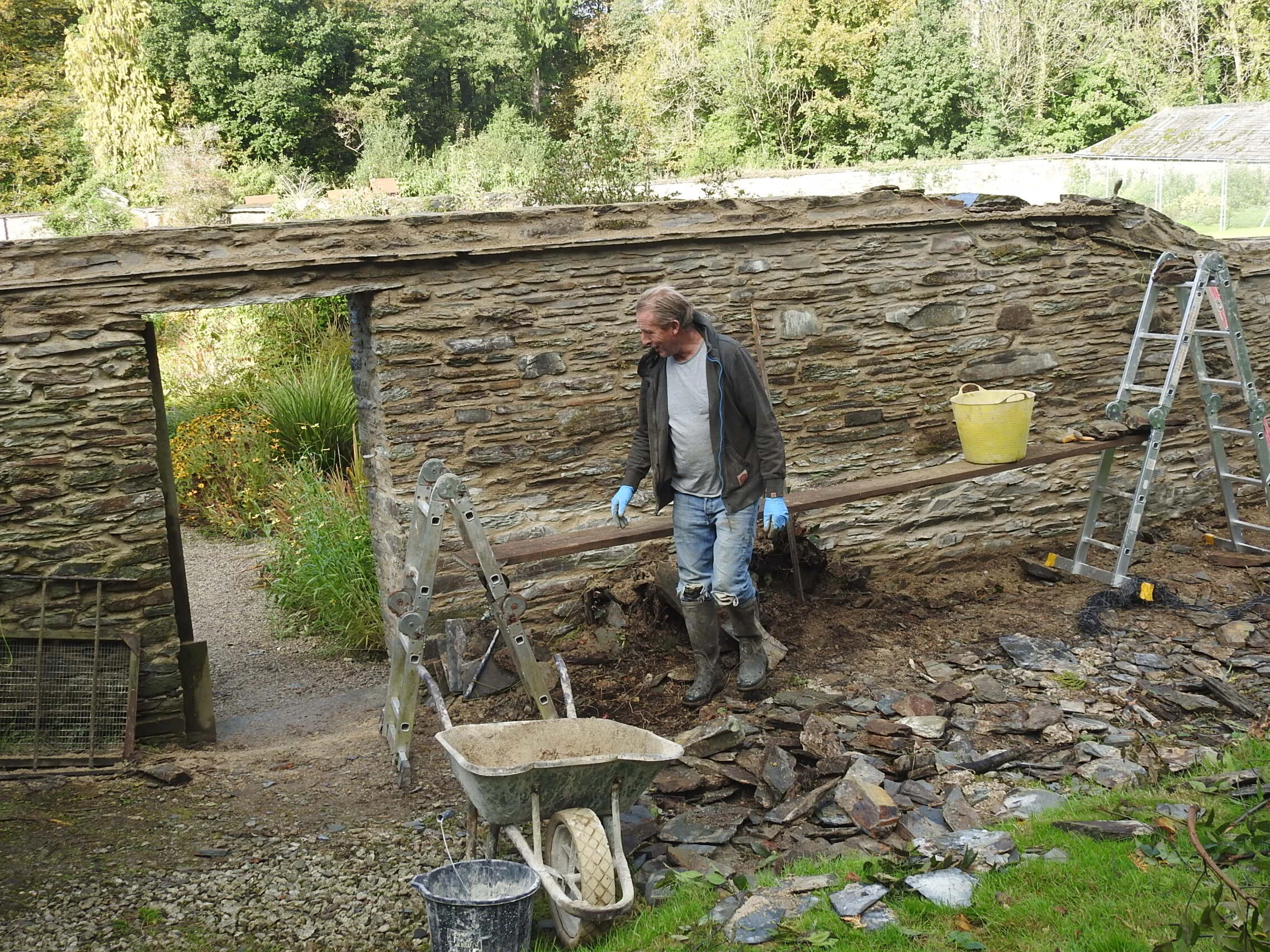
Dave Brown of D B Stonewalling rebuilding a section of wall (7 October 2020)
…………………………………………..………………………………….
Wildlife and biodiversity in the gardens
Occasionally we benefit from flora and fauna surveys undertaken on the estate:
A flowering plants and ferns survey in September 2020: the findings can be seen HERE.
A birds survey at Trevague in 2019: the findings can be seen HERE.
Information from the ‘All the Moor Butterflies’ project (not specifically Trebartha, but there is lots here, including photos of butterflies on Bodmin Moor) can be seen HERE.
The Cornwall Fungus Recording Group visited in September 2016. A list of their findings is HERE.
A flowering plants and ferns survey in September 2020 - see below. The findings can be seen HERE.

Biodiversity survey 29 September 2020: David Pearmain and Ian Retallick holding Nitella translucens
On 29 September 2020, two biologists, Ian Benallick and David Pearmain, spent a day surveying biodiversity in the gardens. (Ian is the East Cornwall recorder for the Botanical Society of Britain and Ireland.). Afterwards Ian wrote:
…. Please find attached the list of species we recorded yesterday in SX2577 (Lemarne area) and SX2677 (Trebartha area) - see List - and a map showing our route of walk and locations of more interesting species we recorded - see Map. These are -
Tunbridge Filmy-fern (Hymenophyllum tunbrigense)- on boulders by the Withey Brook. Found in granite areas of Cornwall in crevices on tors, on boulders in shade, or in clitter, Bodmin Moor, St Austell granite area, Carnmenellis and West Penwith, and a few outlier sites elsewhere.
Pale Sedge (Carex pallescens) - on the dry shaded woodland bank above the fish ponds. local in east Cornwall and often an indicator of Ancient Woodland.
Bottle Sedge (Carex rostrata) - in the corner of the lower fish pond. Common on Bodmin Moor in mires, scattered in mid-Cornwall, rare in other parts of Cornwall.
Alternate-flowered Water-milfoil (Myriophyllum alterniflorum) - large masses of plants in the River Lynher along Ladies Mile. Scattered along upper stretches of the rivers Tamar, Ottery, Kensey, Inny, Lynher, Fowey, Camel, De Lank, West Looe, frequent in wetland areas on the Lizard and scattered elsewhere.
Ivy-leaved Bellflower (Wahlenbergia hederacea) - large patch of plants in mown grassy area by ditch west of Swan Lake. Frequent in granite areas on Bodmin Moor, St Austell granite area, Carnmenellis and West Penwith, and a few outlier sites elsewhere.
It was a very successful day as we recorded over 200 species in each 1km x 1km square, and these totals are closer to what is to be expected in a 1km x 1km square in Cornwall that is not all moorland.
SX2577 (Lemarne area) had only 117 species recorded after 1999 out of a total of 134 ever recorded. It is now 234 after 1999 and 240 in total ever.
SX2677 (Trebartha area) had only 158 species recorded after 1999 out of a total of 134 ever recorded. It is now 220 after 1999 and 256 in total ever.
It would be good to come back again, a springtime visit would add those spring species we would not have seen yesterday.
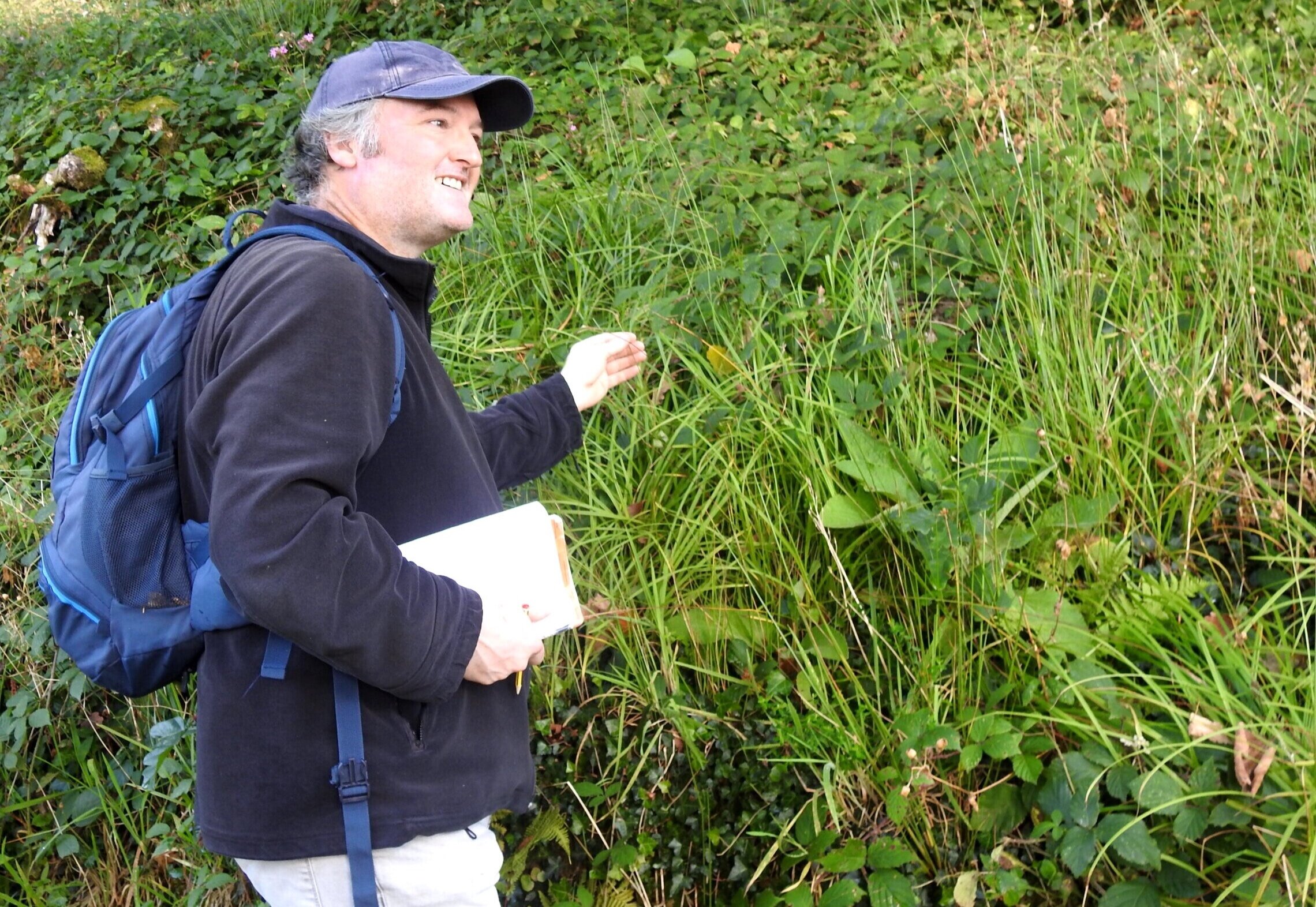
Ian Benallick pointing out a patch of Pale Sedge (Carex pallescens) on the bank above the middle fish pond.
Pale sedge, bluebells and wood anemones are all indicators of ancient woodlands.
…………………………………………..………………………………….
‘Trebartha Waterways’
On 16 July 2020, Emma Phillips, on her own initiative sent the family an email with her thoughts and a paper she had written on Trebartha Waterways, which can be seen here.
…………………………………………..………………………………….
Trebartha Gardens Strategy
This was circulated with Trebartha Newsletter 22 (October 2019)
1. INTRODUCTION
Trebartha has been described as having “the finest landscape gardens in Cornwall”. The significant features at Trebartha include water, trees, and rocks, and, on one side, a steeply sloping site running down to the river Lynher. Different areas have distinctive characters and planting. The gardens are unusual in being managed, with limited resources, as a long-term family trust for the benefit of an ever-growing number of family shareholders. They are expected to remain private, and to continue opening to members of the public and private groups on a few occasions each year. The value of the gardens is enhanced by the great affection that family that members have for them and the history of Trebartha.
2. AIM
Our aim is to conserve and enrich the gardens for the benefit of current and future generations. We want the landscape, amenities and planting to make it, first, treasured as a family asset and, second, appreciated by others as one of the finest gardens in Cornwall.
3. OBJECTIVES
Our objectives are to:
Plan and manage the gardens with the long term in mind as well as the short and medium term.
Respect and improve the gardens’ status, character, history and integrity.
Enhance the natural landscape of the different areas.
Follow good environmental and conservation practices and take climate change into account
Provide more walking routes, places to sit and relax, and places where family members of all ages can get together for activities and interact with the natural world
Learn and share more about the gardens’ natural resources, ecology and conservation
• Record and make available information about the gardens, including their history, plants, ecology, and particular features of interest.
Consult the family on major issues, and take into account all comments and suggestions
Manage the gardens within the limited budget available from Trebartha Estates, supplemented by donations and other support from family members.
Agree short, medium- and long-term management plans for the different areas within the gardens, which take anticipated resources into account
Set measurable objectives, and keep objectives and performance under review.
4. GENERAL MANAGEMENT OBJECTIVES
We will prepare and implement a detailed Gardens Management Plan, which will include:
Maintaining and increasing: the ‘wow factor’, walking routes, viewpoints, areas for family members and friends to enjoy together, secluded areas, and “hiding places”
Creating and maintaining woodland and waterside planting which enhances the landscape, is appreciated by the family and provides interest all year round, and especially from spring to autumn
• Planting and nurturing specimen trees and shrubs which future generations and plantsmen will enjoy
• Improving the diversity of wildlife habitats and the sustainability of gardening techniques
• encouraging everyone to respect the gardens and adjacent farmland, and leave no trace of their visits
• Recording existing and future planting, investing in appropriate mapping and labelling systems
• Keeping the state of our tree collection under review all year round, carrying out annual tree safety surveys, and taking appropriate action
• Preparing and implementing a schedule of maintenance and repair work within agreed timelines
• Maintaining the gardens primarily for the benefit of the family, restricting public access to designated dates
• Giving the public, special interest groups and other groups access to the gardens several days a year, enabling them to enjoy Trebartha; the family to benefit from their comments and expertise; and charities or the gardens to benefit from the net income
• Valuing and investing in our staff
• Developing external links with people with useful knowledge and expertise for mutual benefit, including owners and gardeners of other gardens
• Seeking and assessing feedback from family members and others on the gardens, to help measure progress and inform planning
• Keeping the cost and benefit of external links and open days under review
• Using our limited resources in the most effective manner, with a focus on medium and long-term outcomes
• Ensuring all plans for the gardens match available resources, where necessary seeking additional funding for special projects from family members.
5. MANAGEMENT PLANS
We will prepare and implement detailed Gardens Management Plans for the primary garden areas, which will include descriptions, maps, history, vision, and short, medium- and long-term objectives.
(September 2019)
…………………………………………..………………………………….
Developing a vision
In April 2015, family members were sent a questionnaire about the gardens. This proved to be a very useful exercise. A summary of the responses can be seen here. We are likely to use questionnaires again.
A management plan for the fish ponds has been drafted. The family will be consulted on the main points in it later this year. For reference, many fish ponds photographs taken over the past ten years are on this website.
…………………………………………..………………………………….
The Millennium Plantation
During 2001, 77 young trees, sponsored by members of the family, were planted at the north-western end of the American Garden. Details can be seen here.
…………………………………………..………………………………….
Replanting following clearance of Rhododendron ponticum
During 2010, several areas of the gardens were found to be infected by Phytophthora ramorum (sudden oak death). This is a fungus-like pathogen which has killed American oak, hence the common name. There are fears that, as well as damaging larch grown for timber, it could mutate and damage English oak. In the UK, Rhododendron ponticum and Japanese larches are the most serious host plants, as spores are produced on these infected plants, which spread the disease further. The disease is water-borne, and plants are most likely to be susceptible if they are densely grown or otherwise stressed.
At Trebartha, large scale clearance took place around the swan pool, American garden, Withey Brook, the fish ponds, and small scale clearance of infected areas in other parts of the gardens. Old pictures on the Photographs pages give a sense of the scale of the change.
Instead of Rhododendron ponticum, we have many young trees, including Alders (Alnus glutinosa and Alnus glutinosa Imperialis), Tilia henryana, and English Oak (Quercus robur) along the Ladies Mile. Around and above the swan pool there are young Davida Involucrata, Crataegus lavallei, Crataegus laevigata, Noble Fir (Abies procera), Grand Fir (Abies grandis) and some big leaf rhododendrons. There are also many more spring bulbs. Some hellebores have been planted on the mound behind the boathouse.
The American Garden has seen massive change, because of the R. ponticum clearance and construction work for the Trebartha Hydro Power project. Replanting has started, using mainly American trees, shrubs and grasses. There are some photos on the American Garden photographs page HERE. The draft planting plan can be seen by clicking HERE.
More replanting will take place in the years ahead. The aim is to respect the special nature of the site, provide greater all-year-round interest, encourage a wider range of wildlife, and create a special, beautiful and atmospheric space for the enjoyment of current and future generations.
…………………………………………..………………………………….